Learn More
Below you will find information regarding flights.
Equipment Used
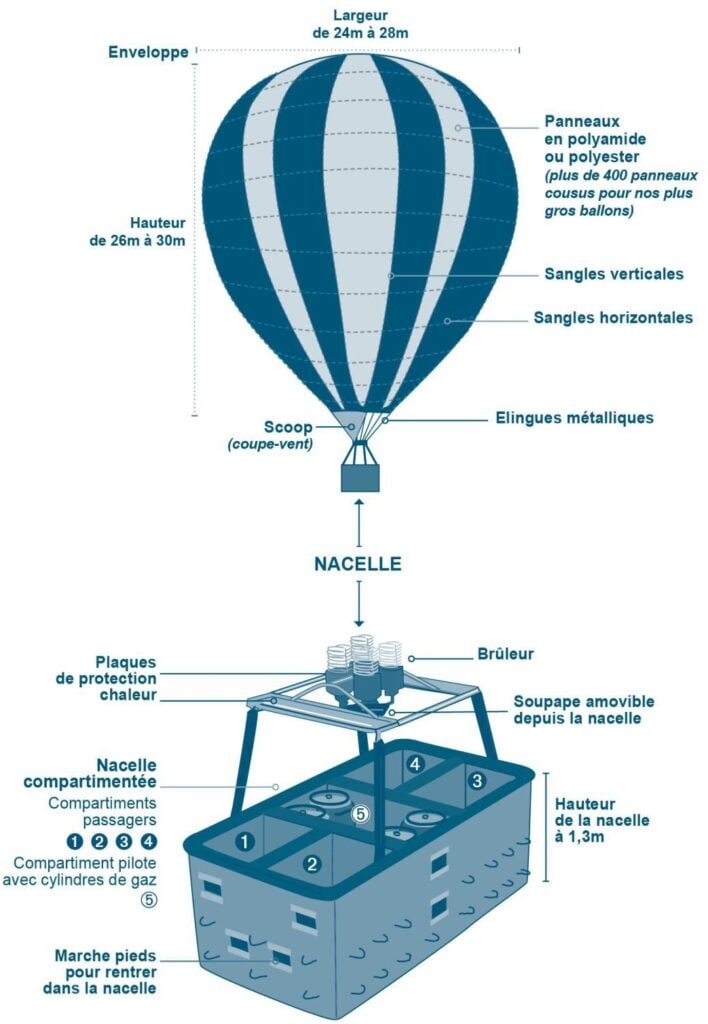
Flights take place in baskets shared with other passengers.
The baskets are compartmentalized and have a maximum capacity of 12 passengers. Several balloons can fly simultaneously.
About Us?
A professional, human-sized structure, Aérovision has specialized in flights in Alsace since 1988 and has welcomed thousands of passengers aboard its baskets. We market and operate our flights directly, without intermediaries, thanks to a small fleet of 4 hot air balloons in our colors.
The specific characteristics of flights in Alsace, between mountains and vineyards, have allowed Aérovision’s pilots to acquire unique expertise.
This experience enables us to offer high-quality flights.
Aérovision is registered as a Commercial Operator (FR.DEC.318) with the DSAC (Direction de la Sécurité de l’Aviation Civile).
Aérovision holds a license as a Combined Airworthiness Organization (FR.CAO.0022) issued by the DGAC (Direction Générale de l’Aviation Civile) for the maintenance and management of its fleet.
Flight Duration
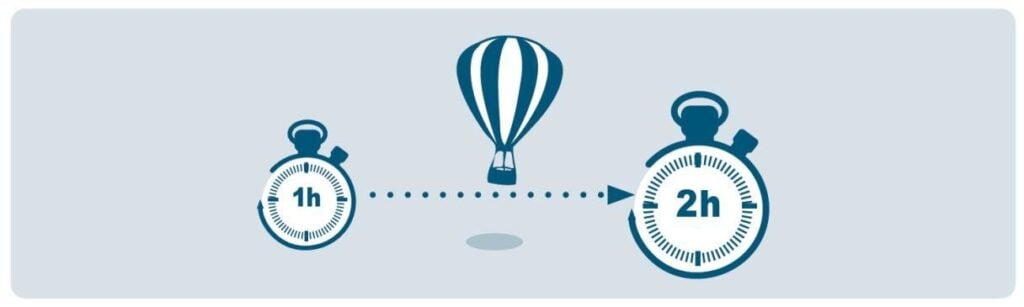
While the average duration of our flights often exceeds 1 hour 30 minutes, this duration can vary as it depends on in-flight gas consumption, as well as factors related to air mass or safety constraints.
Flight parameters affecting gas consumption are:
- Altitude reached (the higher the altitude, the more gas the balloon will consume).
- Outside temperature (the hotter it is, the more the inside of the balloon needs to be heated).
- Total loaded weight (the heavier a basket is, the more the internal temperature of the balloon needs to be increased).
To ensure the longest possible flight duration, Aérovision uses balloons that are oversized relative to the weight lifted. - Presence of wind shear, which exerts pressure on our envelopes and forces us to compensate for heat loss.
- Type of flight performed. Some flights consume more gas because we make round trips between altitude and ground, due to flight opportunities or technical necessities.
Other parameters that can affect flight duration are:
- Thermals appearing, meaning turbulence or instabilities caused by the sun warming the air mass.
- Premature cessation of katabatic winds (cool ground winds that descend along mountain slopes). These winds allow reaching accessible areas, which are always located at the bottom of the valleys.
During warm periods, these cool winds stop more quickly than during cooler periods. - Strengthening of winds after the dawn calm.
- Upcoming obstacles. If winds push the balloon towards areas unsuitable for landing, it is better to land before entering them.
While Aérovision aims to maximize flight duration, this is always done within precise safety limits and in compliance with air regulations, which require us to land well before our gas reserves are depleted.
The pilot decides the timing and location of landing, always prioritizing passenger safety.
Balloon Movement and Trajectory
A hot air balloon is not steerable. The wind determines its path and the distance it will travel.
While embracing the winds and aerological opportunities contributes to the pleasure of the flight, it also means that a specific trajectory cannot be guaranteed.
The take-off location is chosen based on wind direction and available maneuvering space. The pilot influences the balloon’s trajectory by changing altitude during the flight, to catch a favorable wind that brings it closer to its destination, when possible.
Upon landing, the pilot will choose an available field as a landing site, depending on opportunities or wind speed (some landings require large fields, while others can be made in confined spaces).
Flight Season / Flight Type
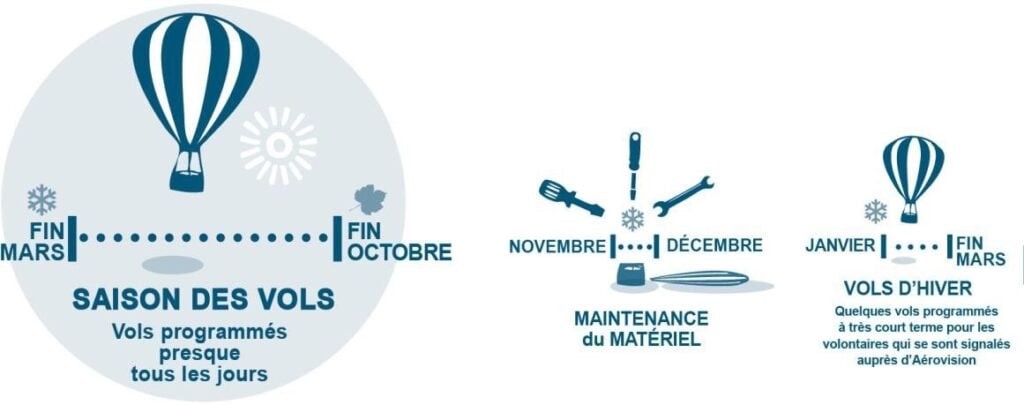
2 types of flights are offered:
- Flights from Late March to Late October:
During this period, we organize flights every day.
Passengers are free to choose a flight date by calling our office or by logging into the website’s booking module. - Flights from January to Late March:
For these winter flights, which allow crossing the Vosges ridges, the organization is different:- Volunteers must register with Aérovision.
- When weather conditions are optimal, Aérovision contacts volunteers to propose a flight date.
- If the flight was not possible during winter, passengers contact us again to choose a flight date, starting from early April.
Weather Conditions
Good weather conditions are essential for your flight’s safety. Hot air balloons cannot fly under the following conditions:
- Rain (or risk of rain).
- Low clouds limiting both horizontal and vertical visibility.
- Fog.
- Unfavorable wind speeds:
- Too much wind: average wind at take-off or landing, as well as gusts.
- Winds at high altitude that are too fast, with turbulence or shear.
- Winds too weak at all altitudes. The purpose of the flight is not to hover in place for 1 hour 30 minutes.
- Risk of thunderstorms or unstable air mass.
The path of thunderstorms is unpredictable, and some storms can generate dangerous updrafts and winds more than 60 km from their core. - Air mass temperature too high for flight, as we would exceed the balloon’s physical limits.
- Wind directions that would not allow us to land in a suitable area.
Flight confirmation or cancellation is based on meteorological forecasts from aeronautical models, which are much more precise than forecasts from your smartphones or general weather websites.
We wait until the day before the flight before deciding to maintain or cancel a flight, due to the sometimes unpredictable and changing nature of forecasts and the microclimate of the Colmar region.
In any case, we will only fly if the flight conditions are truly favorable.
If we decide to cancel a flight, it is because we have detected a real or potential risk that would make the flight perilous for passengers or the balloon.
Before meeting you, we verify that the forecast matches reality. Rarely, we may cancel the flight at the launch site if we find that the forecast does not match reality.
Flight Schedule
Flights take place exclusively within 2 hours after sunrise, the only time a hot air balloon can fly safely (absence of thermal winds related to the sun).
Approximate meeting times:
Month | Morning |
January | 7:30 AM |
February | 7:00 AM |
March | Between 6:00 AM and 6:45 AM |
April – Mid-May | Between 5:15 AM and 6:00 AM |
Mid-May – July | 5:00 AM |
August | Between 5:15 AM and 5:45 AM |
September | Between 6:00 AM and 6:45 AM |
October | Between 6:45 AM and 7:15 AM |
Due to climate change and the specific weather conditions in Colmar, it is no longer possible to fly in the late afternoon.
Booking a Flight Date
We conduct flights on weekdays as well as on weekends and public holidays.
Depending on demand, some weekends can fill up quickly, and it can sometimes take up to 2 months to find a flight date (especially when we experience a period of bad weather with postponed flights).
We ask passengers with weekday availability (days off, holidays, retirement, etc.) to prioritize a weekday flight date, as Aérovision’s passenger capacity remains low and we can only operate one flight per day. The waiting period for weekday flights is shorter than for weekend flights.
To book your flight date:
- Online, by clicking here.
- Call us on weekdays, from 10:00 AM to 12:00 PM and from 2:00 PM to 4:00 PM at 03 89 77 22 81.
Tips:
- Don’t wait for good weather to schedule a flight date.
- Do not wait until the end of your voucher’s validity to schedule a flight date. In case of bad weather and an expired validity date, your ticket might become invalid.
Main Passenger / Accompanying Passenger
When booking a flight date, we ask you to provide:
- The main passenger
- The accompanying passenger(s)
The main passenger is the one who manages the accompanying passengers and receives the most information related to the booking:
- SMS confirmation of the flight date booking. If you have not received an SMS, please contact us so we can make the necessary corrections.
- Flight date reminder: 5 days before the scheduled flight.
The day before the flight, the main passenger and accompanying passengers whose mobile phone numbers have been provided to us will receive the flight confirmation message.
The main passenger will receive an email confirmation with information on the expected temperature for the flight, as well as directions to the meeting point.
If the flight is a surprise, you are not required to provide us with the contact details of accompanying passengers.
Flight Confirmation (the day before)
The day before the flight, before 4:00 PM, passengers (the main passenger and any companions whose contact details we have received) will receive an SMS:
- If the flight is maintained, we will indicate the time and meeting location.
The main passenger will receive an email with the expected temperatures and a map to the meeting point. - If the flight is canceled (due to weather), you can rebook a flight date via the website or by phone call during office hours.
Meeting Locations
The meeting point is a free, easy-to-find parking lot. There is no need to look for an Aérovision office.
Aérovision will pick up passengers with its own vehicles. They are easily recognizable; we tow a large trailer with the basket.
Punctuality
It is important that you are punctual at the meeting time provided to you.
We will not be able to wait for passengers who are late or lost on the way, as your delay would impact the flight’s safety margins.
Therefore, plan to be present 10 minutes before the indicated time.
In case of an issue, an emergency line at 06 09 78 51 16 is available 30 minutes before the meeting time. This number should only be used in case of emergency.
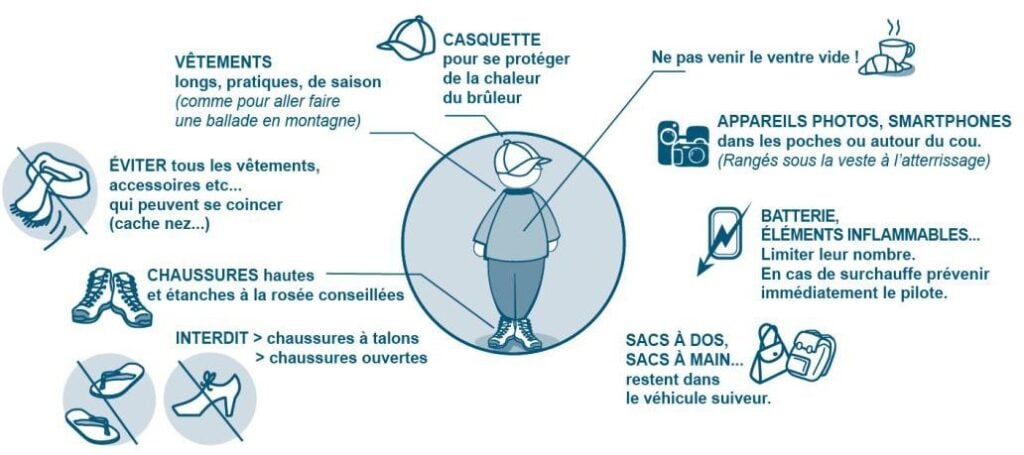
Flight Equipment & Clothing
Special note on clothing:
Upon flight confirmation by email, we will indicate the expected temperature at ground level and at 1500m altitude. Based on these temperatures, you can dress accordingly.
In the balloon, we benefit from the burner’s radiation and the envelope’s temperature, which exceeds 80°C. The temperature in the basket is higher than the ambient air.
Furthermore, as the balloon moves at the same speed as the wind, there is no additional sensation of cold caused by air movement.
Flight Instructions
Pre-flight Briefing
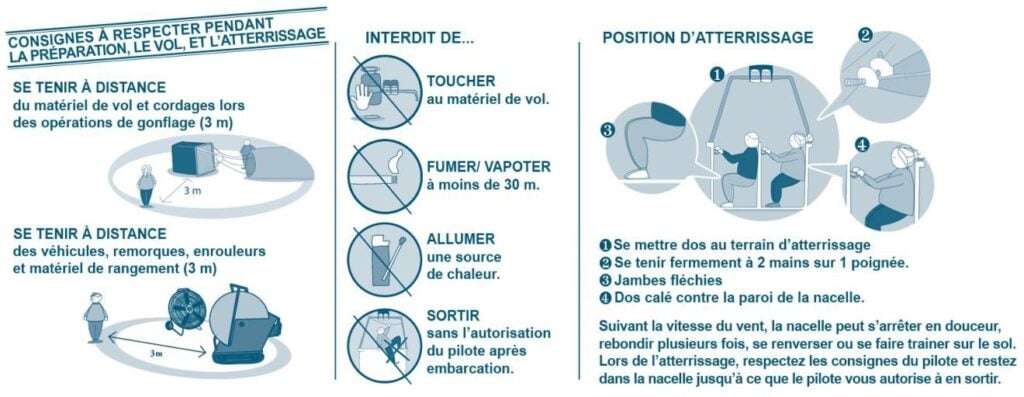
At the launch site, time will be dedicated to providing safety instructions. We ask passengers to remain attentive during this time, avoiding distractions for photos or clothing preparations, for example.
During balloon inflation, you will have time to prepare and unload unnecessary belongings.
Instructions for Launch and Landing Sites
To minimize our impact on the sites that host us, we ask you to observe a few common-sense practices:
- Avoid flattening the grass by walking across the field.
- Picking or pulling up plants and fruits.
- Avoid throwing anything (including cigarette butts).
The take-off/landing fields are private properties that Aérovision does not own. For Aérovision, it is vital that the presence of a balloon impacts the landowners as little as possible in order to maintain the most cordial relations with them.
Non-flying Companions
The presence of non-flying companions who wish to attend the take-off is possible but strictly regulated. As the take-off field takes on a status similar to an airport, only passengers and crew are authorized to enter the take-off field.
The rules are as follows:
- During the transfer to the take-off fields, companions must not drive between Aérovision vehicles.
- Access roads to the launch site must remain clear of any parked vehicles to facilitate the potential passage of emergency vehicles.
- Companions are not allowed to approach the balloons and must stay behind a designated barrier. Companions will not be able to enter the field, even after take-off, as the crew members are maneuvering with vehicles and trailers.
Since the balloon is not steerable, no one knows its landing location.
We advise companions against following Aérovision vehicles:
- They use muddy and bumpy roads where 4×4 vehicles are necessary. Ground crew members will not be able to stop to assist them.
- They sometimes have to use roads prohibited to vehicles other than ours. In case of inspection, the companion would be fined.
- They use private roads and enter private properties to retrieve the equipment. The owner would not appreciate being overrun by a horde of companion vehicles.
Due to abuses and damage caused by companions, Aérovision requests that companions pick up their passengers at the meeting point, 4 to 5 hours after the scheduled meeting time.
Minimum Boarding Requirements
Hot air ballooning remains a sporting activity.
Our flights are prohibited for:
Pregnant women
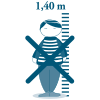
Individuals under 7 years old or under 1.40 m

For individuals with medical contraindications

Individuals with a sprain, fracture, unstable dislocation, or recent surgery

To board, passengers must:
Be autonomous, able-bodied, and understand instructions

Stand for 2 hours
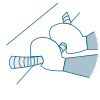
Hold firmly onto a handle with both hands to avoid being ejected
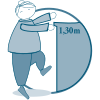
Climb into the doorless basket using small steps
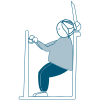
Adopt the landing position (legs and knees bent - back against a wall)
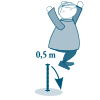
Withstand a potential impact during landing (similar to a 50cm jump)

Vulnerabilities to report to us:
Osteoporosis
Prostheses (knees, hip)
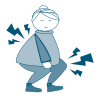
Any other vulnerability related to age or health (non-exhaustive list)

Aérovision does not have medical qualifications. Passengers are required to inquire with their doctor about their fitness to undertake a hot air balloon flight.
When vulnerabilities are reported, Aérovision will check if it can implement additional mitigation or safety measures to accommodate these passengers under the best possible safety conditions.
Passengers are required to inform Aérovision of any changes or developments related to boarding conditions.
Children aged 7 to 12 must be accompanied by a responsible adult.
From experience, we have noticed that children who are too young do not enjoy a flight, and after admiring the scenery for 10 minutes, they may end up getting bored.
The child’s maturity and awareness of nature are paramount before considering a hot air balloon flight for them.
Incorrect declaration:
In the event of an incorrect declaration or failure to declare the minimum boarding conditions, the pilot-in-command may refuse the passenger's boarding on the day of the flight. The ticket would then be considered used.